

Written and medically reviewed by Dr. Dimitri Gitelmaker, MD
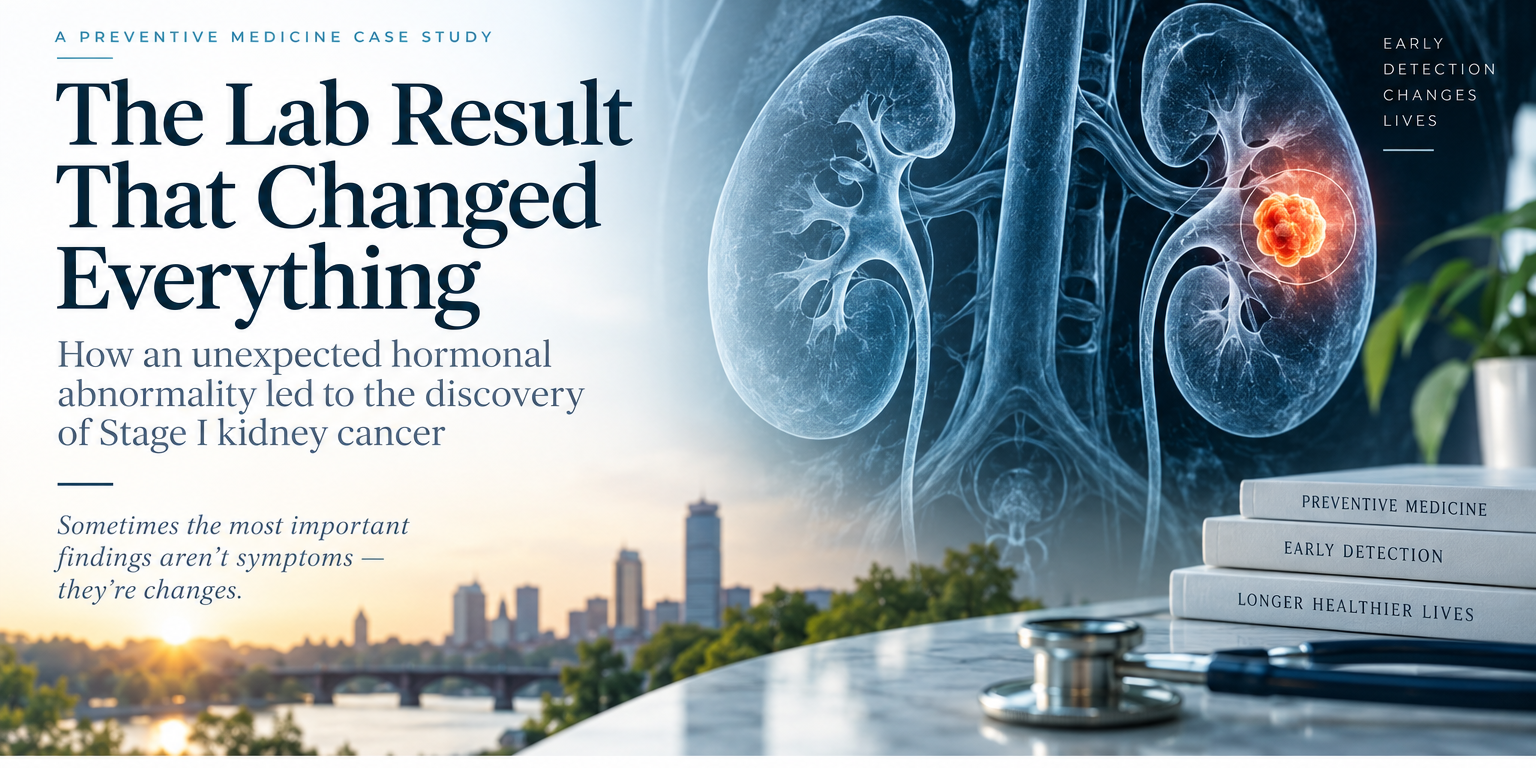
The Lab Result That Changed the Course of a Cancer Diagnosis
How an unexpected hormonal abnormality led to the discovery of Stage I renal cell carcinoma
By Dimitri M. Gitelmaker, MD
GitelCare Concierge & Longevity Medicine
A Preventive Medicine Case Study
One of the most important ideas in preventive medicine is also one of the simplest: a laboratory result does not exist in isolation. Its meaning comes from context, from physiology, and often from how it changes over time.
A value that looks only mildly abnormal on a single report may become far more meaningful when compared with a patientâs own baseline.
That principle became especially important in the care of one of my patients, a man in his 50s who felt entirely well and had no symptoms that would ordinarily suggest kidney cancer.
During routine longitudinal laboratory monitoring, his luteinizing hormone, or LH, rose from previous measurements in the mid-3 mIU/mL range to 9.4 mIU/mL.
On its own, that result did not point to renal cancer. LH is not a kidney-cancer biomarker, nor should an isolated elevation in LH trigger abdominal imaging in every patient. In men, an elevated LH level is generally interpreted in the context of gonadal function, testosterone production, medications, hormone therapy, and the hypothalamic-pituitary-gonadal axis.
What made this result important was not that it was specific for a particular disease. It was important because it represented a meaningful and unexplained change from this patientâs prior physiology.
The question was not simply whether the LH was outside the reference range. The more important question was: Why had it changed?
That question led to a broader evaluation and, ultimately, cross-sectional imaging of the abdomen.
The MRI revealed a renal mass.
Further evaluation confirmed what the patient had given us no clinical reason to suspect: he had a localized Stage I renal cell carcinoma.
The cancer had been silent.
The Blood Test Did Not Diagnose the Cancer
The significance of this case is not that an elevated LH âfoundâ a kidney cancer. That would be scientifically inaccurate.
The significance is that an unexpected biological change was not dismissed as noise. It was treated as a signal that deserved an explanation.
The investigation that followed happened to uncover a clinically silent malignancy while it was still confined to the kidney and amenable to definitive treatment.
This distinction is important.
LH is not an established screening marker for renal cell carcinoma, and there is no evidence that an isolated elevation in LH should routinely prompt kidney imaging. But preventive medicine is not about mechanically reacting to individual numbers. It is about recognizing when a patientâs physiology changes in a way that does not make sense.
Sometimes the explanation is benign. Sometimes it is related to medication, aging, hormonal therapy, or another known process.
And sometimes, investigating the change uncovers something far more important.
Kidney Cancer Can Be Remarkably Quiet
Kidney cancer is particularly relevant to this discussion because early renal cell carcinoma can remain clinically silent for a prolonged period.
Many patients with localized disease have no hematuria, no flank pain, no palpable mass, and no constitutional symptoms. The classic triad historically associated with kidney cancer is uncommon in modern practice.
Today, many renal tumors are discovered incidentally during CT, MRI, or ultrasound performed for an entirely different reason.
That creates a challenge for physicians practicing preventive medicine: how do we recognize meaningful disease early without simply scanning everyone?
The answer is not indiscriminate testing.
It is thoughtful risk assessment, attention to longitudinal data, and judgment about when a change warrants deeper investigation.
Why Stage at Diagnosis Matters
The importance of early detection becomes clear when we look at the natural history of kidney cancer.
For disease that remains localized to the kidney, five-year relative survival is approximately 93%. Once kidney cancer has spread to distant organs, survival drops dramatically.
Those statistics do not predict what will happen to any individual patient, but they illustrate one of the most fundamental principles in oncology:
the stage at which a cancer is discovered can profoundly alter treatment options and long-term prognosis.
For this patient, the most important number in the entire case was not an LH of 9.4.
It was:
Stage I.
Because the disease was found while still localized, he was able to undergo treatment with curative intent.
From Detection to Definitive Treatment
Once the renal mass was identified, the priority shifted immediately from investigation to definitive oncologic management.
The patient was referred to Brigham and Womenâs Hospital and Dana-Farber Cancer Institute in Boston, within the Harvard Medical Schoolâaffiliated academic medical system.
His care was managed by Steven L. Chang, MD, MS, Chief of Urologic Oncology at Brigham and Womenâs Hospital and a member of the Harvard Medical School faculty.
He underwent definitive surgical treatment.
Today, he has no evidence of disease and continues appropriate surveillance with follow-up imaging and monitoring of renal function.
That phraseââno evidence of diseaseââis deliberate. Even after successful treatment of localized renal cell carcinoma, ongoing surveillance remains an important part of care.
Why Early Kidney Cancer Is Often Treatable
For localized renal cell carcinoma, surgery remains the principal potentially curative treatment.
When technically appropriate, surgeons often perform a partial nephrectomy, removing the tumor while preserving as much normal kidney tissue as possible. Other patients may require a radical nephrectomy, while selected small renal masses may be appropriate for active surveillance or ablative treatment.
The correct approach depends on the size and location of the tumor, kidney function, pathology, age, comorbidities, and overall clinical context.
The key point is that early-stage disease gives patients options.
Advanced disease gives us fewer.
Renal Cell Carcinoma Can Produce Unusual Biological Signals
Renal cell carcinoma has long been known for producing a wide variety of systemic and paraneoplastic effects.
These can include abnormalities in red-cell production, calcium metabolism, inflammatory markers, liver-related laboratory values, blood pressure, and other systems. Rare renal tumors have also been associated with ectopic hormone production.
None of this establishes LH as a screening marker for kidney cancer, and it would be inappropriate to claim that the renal tumor directly caused the LH elevation in this individual case.
The medically defensible conclusion is narrower:
an unexplained physiological change led to an investigation that uncovered an occult malignancy.
That is an important distinction because it preserves both the scientific accuracy of the case and the larger lesson.
Does This Mean Everyone Should Get an MRI?
No.
There is currently no recommendation for routine MRI, CT, or ultrasound screening for kidney cancer in average-risk adults.
Broad imaging of healthy populations can create its own problems, including incidental findings, unnecessary biopsies, procedures for indolent lesions, cost, anxiety, andâin the case of CTâradiation exposure.
Preventive medicine should not be confused with maximal testing.
The objective is not to test every person for every possible disease.
The objective is to identify when additional testing is justified.
Who Is at Higher Risk for Kidney Cancer?
Risk assessment still matters.
Established risk factors for renal cell carcinoma include tobacco use, obesity, hypertension, family history, and certain inherited cancer syndromes.
These factors do not mean that a person will develop kidney cancer, but they can influence how aggressively a physician evaluates new symptoms, abnormal laboratory findings, or incidental imaging results.
They also reinforce an important point about prevention: while not every kidney cancer can be prevented, smoking cessation, weight management, blood-pressure control, protection of kidney function, and attention to family history remain meaningful parts of long-term risk reduction.
The Bigger Lesson: Trends Matter
The broader lesson from this case extends well beyond kidney cancer.
Much of modern medicine still interprets laboratory testing as a series of snapshots: normal or abnormal, flagged or unflagged, in range or out of range.
But human physiology is dynamic.
The more useful question is often not:
âIs this result normal?â
It is:
âIs this normal for this patient?â
A laboratory value can remain within a population reference range while changing meaningfully from an individualâs baseline. Conversely, a result can sit slightly outside a reference interval and have little clinical consequence.
The art of medicine lies in distinguishing one from the other.
That requires knowing the patientâs trajectory. What has changed over six months or two years? Does the change fit with medications, age, treatment, weight, or lifestyle? Is it persistent? Does it make physiologic sense? Is there a plausible benign explanation, or does the pattern warrant a deeper look?
Those questions cannot be answered simply by looking at whether a laboratory portal has colored a number red.
Preventive Medicine Is Not More Testing. It Is Better Judgment.
Preventive medicine, at its best, is not about ordering more tests.
It is about recognizing meaningful change early enough to act on it.
In this case, an unexpected hormone abnormality created a question. The question led to an investigation. The investigation led to an MRI. The MRI revealed an otherwise silent Stage I kidney cancer.
The patient was treated at a Harvard Medical Schoolâaffiliated academic cancer center and today has no evidence of disease.
That is the kind of outcome we hope preventive medicine can createânot because every abnormal result conceals a cancer, and not because every patient needs more imaging, but because occasionally a subtle change is the first indication that something important is happening beneath the surface.
The responsibility of the physician is to know when to ignore the noiseâand when to follow the signal.
Key Takeaways
- Elevated LH is not a recognized screening marker for renal cell carcinoma.
- In this case, the importance of the LH elevation was that it represented an unexplained change from the patientâs prior baseline.
- The resulting evaluation led to imaging and the discovery of an asymptomatic Stage I renal cell carcinoma.
- Kidney cancer can remain clinically silent until relatively late in its course.
- Localized kidney cancer is often highly treatable and may be cured with surgery.
- Routine kidney-cancer imaging is not recommended for average-risk adults.
- Preventive medicine works best when physicians combine longitudinal data, individual risk, clinical judgment, and appropriate testing.
References
- American Cancer Society. Key Statistics About Kidney Cancer.
- American Cancer Society. Survival Rates for Kidney Cancer.
- American Cancer Society. Can Kidney Cancer Be Found Early?
- European Association of Urology. EAU Guidelines on Renal Cell Carcinoma.
- Campbell SC, et al. Renal Mass and Localized Renal Cancer: Evaluation, Management, and Follow-Up: AUA Guideline. Journal of Urology. 2021.
- Moldovan T, et al. Incidence and clinical relevance of paraneoplastic syndromes in patients with renal cell carcinoma. Urologic Oncology. 2023.
- National Cancer Institute. Renal Cell Cancer Treatment (PDQ).
This case has been de-identified for patient privacy. Certain nonessential details may be generalized. Elevated LH is not an established biomarker for renal cell carcinoma, and this case should not be interpreted as a recommendation for routine renal imaging in patients with isolated LH elevation. The article is intended for educational purposes and should not replace individualized medical evaluation.
About GitelCare
GitelCare Concierge & Longevity Medicine focuses on advanced preventive care, early disease detection, comprehensive diagnostics, and longitudinal health monitoring. The goal is not simply to treat disease after symptoms appear, but to identify meaningful changes earlier and build a more proactive strategy for long-term health.
Schedule a consultation with GitelCare to learn more about our preventive and executive health programs.


